
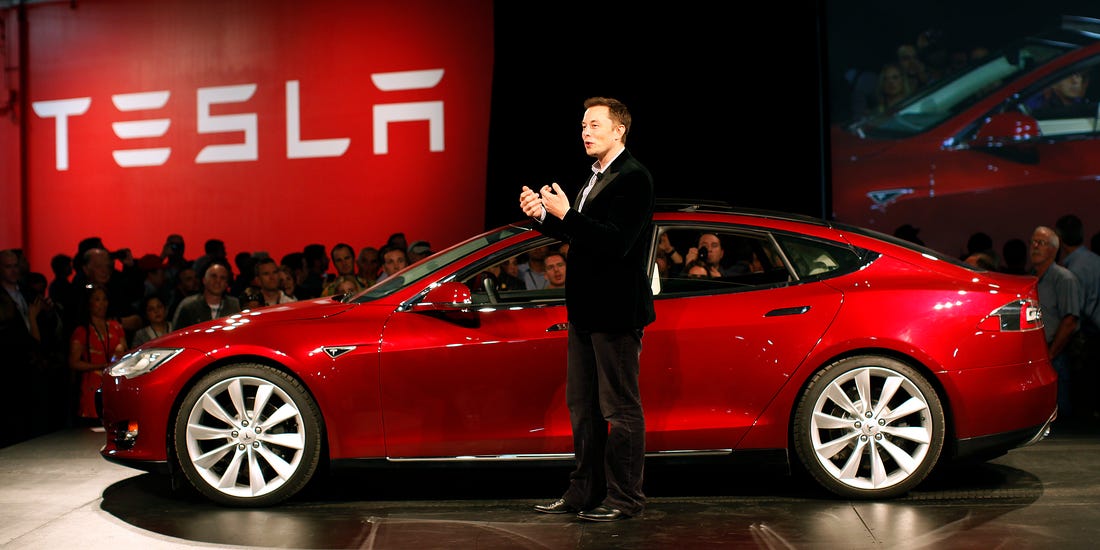
The meteoric rise of Tesla’s stock price, from its lows in the $420s in March, to its current price of $1,370 ( 11 August 2020) have raised many questions about Tesla’s valuation and left many wondering what is next for the electric vehicle company.
Tesla is officially the most valuable autocar maker on the planet, overtaking well established industry giants such as Toyota and Volkswagen. Looking at Tesla from a purely financial standpoint it is very challenging to justify its astronomical market capitalization which stands at over $250bn. This is primarily due to its valuation not being even closely matched by earnings. For instance, the net income for the past 4 quarters has amounted to only $376 million dollars which is by no means impressive for a quarter trillion dollar company. To put this into perspective, their counterpart Volkswagen, valued at $64 billion made over $13 billion in profit and Toyota whose market cap of around $200 billion made over $20 billion in net profit in 2019. One must also take into account that this is the first year that Tesla has actually made a profit, with a long prior history of losing nearly a billion dollars each year. Moreover, the revenue Tesla received from regulatory credit has increased by 64% from last year from $111.2 million dollars to now $428 million which has clearly aided Tesla’s balance sheet immensely toward a profit. Even though Tesla’s CFO expects this stream of revenue to continue to rapidly increase into 2021, it would be wishful thinking to believe that this is a guaranteed long term source of revenue, and for Tesla to live up to the enormous current market capitalization it will need to increase its sales and profits dramatically.
It is even more difficult to justify Tesla’s stock price rising even higher, however there are future opportunities that may ignite another launch in stock price. The most prominent, Tesla being added to the S&P 500. As Tesla has recently met the requirements needed to join the exclusive exchange, it would not be surprising for it to be added in the near future especially due its huge valuation that would rank the electric vehicle company in the top 20 most valuable companies in the exchange. Furthermore the listing would be followed by a massive increase in demand and thus stock price as passive investors will need to sell shares in other companies to add Tesla to their portfolio. This is a likely prospect if Tesla’s share price can avoid major falls and stay at its current high level, in addition to growing their profitability even more than this year. While this is a possible prospect, it is a big ‘if’ and any unexpected hindrances would diminish this possibility and in such uncertain times it may prove very testing.
On the contrary, putting Tesla’s valuation in terms of dollar amount aside, it is difficult to overlook the individuality of the electric vehicle company that has shaken up the whole automotive industry. Moreover, it is hard to ignore the eccentric and controversial CEO, Elon Musk, who consistently makes headlines for news ranging from a successful space lunch with his other company SpaceX to an opinionated tweet that has gone viral. In spite of the far from spectacular financial results in comparison to other automakers, Musk has again successfully demonstrated his ability to ride out another bumpy road, arguably more challenging than 2008, and with an effective response, facing the challenges of both Covid-19 and the civil unrest in the U.S affecting Tesla’s production facilities. Musk’s outspoken personality and powerful leadership should also be taken into consideration when evaluating Tesla, as he is a key factor behind the aura and world wide attention that Tesla attracts. An apt comparison of what Elon Musk is to Tesla, is what Steve Jobs was to Apple, and there is no doubt that Tesla would not be where it is today without him. Musk has led Tesla to pave a new direction for the automotive industry with self-driving technology, cutting out dealerships (buying directly from Tesla, in store or online), and creating a fully electric, highly efficient vehicle whose engine consists of 17 parts as opposed to a fuel operated automobile which has over 200 parts.
As it stands today Tesla’s market share of the automotive market is 1.3 %, however the model 3 dominates the electric vehicle market share, standing at a staggering 60% in the U.S. Even though traditional automakers are aiming to catch up and upcoming competition such as Nikola and Li Auto aim to overtake Tesla, they simply do not have the unique flair and sense of familiarity that resonates with the masses, hence why the seemingly unheard of upcoming competition poses very little threat.
Tesla’s valuation should not be seen as an indication of where the company is today, but where the company is headed. Tesla was founded in 2003 and is therefore a fairly new company, and has only started its journey to lead the auto industry through a profound transformation which will take place over the next 5 to 10 years. According to Goldman Sachs 7 key trends will shape the future of the entire auto industry over the next 5 years. In short these are 1) switching from fuel to electric power, 2) reduce the weight of cars to increase efficiency, whilst following regulations, 3) increase in self driving technology 4) evolving the supply chain to make it more affordable to produce fuel efficient cars 5) New competitors with new technology 6) The internet of cars, meaning cars that connect and communicate with each other to reduce accidents 7) shifting to the emerging markets, bringing affordable vehicles to lower income nations. Tesla is already fulfilling most of these areas and is consistently improving areas such as their self driving technology and plans to eventually create a Tesla model that is affordable to the mass market all over the globe, especially in the emerging markets. Early signs of success can already be seen in China with the affordable Tesla model 3, whose sales in China alone have increased 35% in the past two months, with the model 3 commanding 23% of all Electric vehicle sales in China.
Over a short period of time Tesla has impressivelt built a solid reputation and has come a long way whilst only having released 4 models so far, with the Semi truck, Cyber truck, and the Roadster still awaiting to be released in the next year or so. Bringin in a wide diversification of vehicle types will open up massive new markets for Tesla such as the $360 billion truck market for the Semi truck, the huge pickup truck industry for the Cyber truck which is projected to grow over 4.8% each year and the luxury car market for the Roadster which is projected to reach $733.2 billion by 2026. The whole world and thus the entirety of the auto industry in 2030 will be markedly different to what it is today with many of the previously stated trends shaping how the consumer will buy and how the automaker will sell vehicles. It is clear to see that Tesla is seamlessly not only following these trends but advancing and pushing them up and beyond.
Overall, determining the value of Tesla today and estimating where it will be in the future is not easy by any means, but with Musk at the steering wheel, Tesla is en route to achieve their goals and expand, diversifying into different vehicle markets and binging more of their elaborate vehicles to the mass market, and can one day live up to the value both in dollar amount and potential.
 The Sweeney Club